FU-MPC: Frontier- and Uncertainty-Aware Model Predictive Control for Efficient and Accurate UAV Exploration with Motorized LiDAR

Jianping Li1 Pengfei Wan1 Zhongyuan Liu1 Yi Wang1 Yiheng Chen2 Xinhang Xu1 Rui Jin1 Boyu Zhou3 Lihua Xie1 1 Nanyang Technological University, Singapore 2 The Hong Kong Polytechnic University, Hong Kong 3 Southern University of Science and Technology, Shenzhen, China

FU-MPC Overview

FU-MPC: Frontier- and Uncertainty-Aware Model Predictive Control for Efficient and Accurate UAV Exploration with Motorized LiDAR.

Abstract

Efficient UAV exploration in unknown environments requires both rapid coverage expansion and accurate SLAM. Although motorized rotating LiDARs provide UAVs with an additional actuation channel for shaping sensing geometry online, dedicated control algorithms that explicitly exploit motorized LiDAR motion for autonomous exploration remain largely unexplored.

This paper treats a motorized LiDAR as a controllable sensor and proposes FU-MPC, a Frontier- and Uncertainty-Aware Model Predictive Control framework that regulates LiDAR rotation speed in closed loop to balance exploration progress and localization quality.

FU-MPC introduces two predictive objectives that are amenable to online evaluation: a frontier-gain term estimated from the future swept volume, and a direction-dependent uncertainty metric derived from local geometric constraints using Fisher information and an A-optimality criterion. To satisfy onboard real-time constraints, piecewise-linear surrogates approximate the utility field, enabling high-rate receding-horizon optimization under hardware limits.

We implement a tightly time-synchronized UAV platform with an independently actuated rotating LiDAR module and show that FU-MPC improves exploration efficiency while maintaining robust SLAM performance in complex environments, compared with fixed-pattern scanning and uncertainty-only baselines.
Key Features & Contributions

Controllable Motorized LiDAR

Models LiDAR rotation as an active sensing control input, enabling the UAV to adapt its scanning behavior online instead of relying on fixed-pattern motion.

Frontier-Aware Exploration

Predicts future swept volume to estimate frontier gain, encouraging sensing actions that expand coverage efficiently in unknown environments.

Uncertainty-Aware SLAM

Uses local geometric constraints, Fisher information, and an A-optimality criterion to favor scan directions that support robust localization.

Real-Time MPC

Employs piecewise-linear utility surrogates for high-rate receding-horizon optimization under onboard computation and hardware limits.

System Platform

Independently actuated rotating LiDAR: FU-MPC is designed for a UAV platform equipped with a tightly time-synchronized motorized LiDAR module. The rotating sensor provides an additional actuation channel for shaping the future sensing geometry during exploration.

Hardware Design

(a) Motorized LiDAR Module

Method Overview

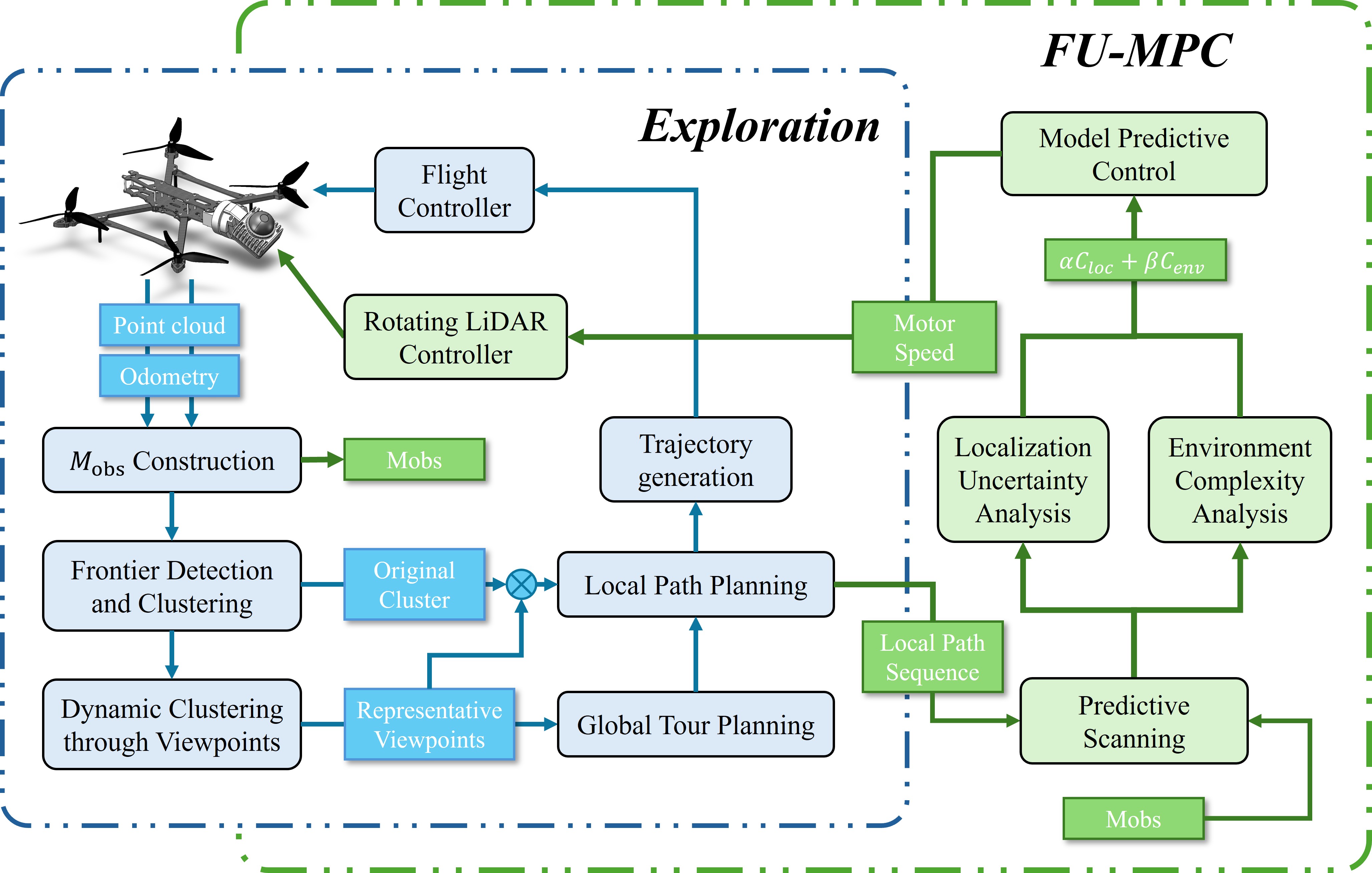
Predictive sensing utility: FU-MPC evaluates candidate LiDAR rotation commands over a receding horizon. The objective combines predicted frontier gain from future swept volume with a direction-dependent localization uncertainty metric, then uses efficient surrogate utilities for onboard optimization.

FU-MPC method overview

FU-MPC Framework

Simulations

Efficient and accurate exploration: FU-MPC is evaluated in complex environments against fixed-pattern scanning and uncertainty-only baselines. The expected results section should report exploration efficiency, SLAM robustness, and runtime performance.

Simulation Results

Simulation 1

Simulation 2

Experiments

Efficient and accurate exploration: FU-MPC is evaluated in complex environments against fixed-pattern scanning and uncertainty-only baselines. The expected results section should report exploration efficiency, SLAM robustness, and runtime performance.

Real-World

Experiment 1

Experiment 2